In a universe filled with planets and moons, comets and asteroids, imagine a robot-controlled spaceship that can send a drill deep below the surface and pull up materials never before seen by human eyes. What
secrets does an alien core hold? What mysteries will it reveal?
For more than half a century, NASA has inspired the scientific imaginations of young people through the challenge of space exploration. Now, the excitement of space engineering is available for kids in the classroom and in after-school
programs through Mission: Solar System; from NASA and Design Squad Nation.
Mission: Solar System is a free, curriculum-based educational resource that includes everything you need to bring the exciting challenges of real NASA engineers to life. There are
leader notes with detailed instructions for each challenge and ideas for making curriculum connections
kids handouts’ with helpful tips and illustrations that enable kids to come up with their own unique solutions to
each challenge.
video profiles of young engineers that explore the direct link between each challenge in Mission: Solar System and real-world problem-solving at NASA.
and do-it-yourself videos are included to model how a group of kids can brainstorm a variety of creative solutions.
Seminole Ridge SECME inspired an interest in the areas of science,
engineering and math during the fifth annual Engineering Family Fun Day was held
Saturday, November 3rd in DreherPark, in West
Palm Beach. Students and their families, teachers and
counselors enjoyed a fun-filled, free educational event focusing on
opportunities available in engineering. Each of the eight sponsored booth presented
a hands on engineering related activity by which the students, parents, and
engineers can interact with each other. For example, the Water Bottle Rocket
involves aerospace engineering.
Last year, Seminole Ridge SECME students challenged children
to learn the physics of projectiles by making a popfly launcher with paint
stirrers, a PVC pipe coupler and a ping pong ball. The mini-catapults were
sponsored in part by Lowe's Home Improvement of Royal Palm Beach, store #0654.
This year, SECME students senior Sam Smith and his brother freshmen Nick Smith, and coach Erich
Landstrom invited event attendees to learn a little more about maps, math, magnets and Mars, by becoming “Inspector Detectors”.
Families had to make a magnetic field detector from simple
objects like steel wool, scissors, and scraps of cardboard. They used their
magnetometers to map for the magnetic anomalies, like the upcoming MAVEN mission to the planet Mars. People who correctly predicted
the locations of magnets hidden beneath a model of Mars received a
passport stamp and a piece of candy. The "Inspector Detector" activity
was adapted from the upcoming “Beyond the Moon” guide written for NASA by the PBS show Design Squad.
The Society of Women Engineers Southeast Florida Section and
the Palm Beach Alumni Extension of the National Society of Black Engineers are
co-hosts.The goal is to inspire an
interest in the areas of STEAM (science, technical, engineering, artistry and math)
fields in students in grades four through 12.
The fifth annual “Engineering Family Fun Day” will be held Saturday, November 3 from 10AM – 2PM in Dreher Park – Pavilion 3 (across from the Dreher Park Zoo) in West Palm Beach. Palm Beach County students, along with their families, teachers and counselors will enjoy a fun filled and educational event. The events’ main focuses are on educating the community on the opportunities available in engineering and inspire an interest in the areas of math and science in students from 4th to 12th grade.
The Society of Women Southeast Florida Section and the Palm Beach Alumni Extension of the National Society of Black Engineers are co-hosts. This event will increase the students’ as well as their parents’, teachers’, and counselors’ awareness and knowledge of engineering and other technical fields.
The event will involve eight booths. Each sponsored booth will present a hands on engineering related activity by which the students, parents, and engineers can interact with each other. For example the Bottle Rocket involves aerospace engineering and Making Polymers involves science and chemistry.
The EF2D event involves sponsored booths. Each sponsor presents a hands on engineering related activity by which the students, parents, and engineers can interact with each other. For example, the Bottle Rocket booth teaches students aerospace engineering and the Making Polymers booth involves chemistry. Last year, Seminole Ridge SECME students challenged children to learn the physics of projectiles by making a popfly launcher with paint stirrers, a PVC pipe coupler and a ping pong ball. The minicatapults were sponsored in part by Lowe's Home Improvement of Royal Palm Beach, store #0654.
(Click on the first picture to flip through a photostream of 2011 EF2D)
We challenge you to…
…build a device that can that you can pass above a surface and detect magnetic fields.
1. Brainstorm and Design
• How can you make sure that the metal shards stay in your detector and not fall off?
· How can you make it easy to see when the metal shards move?
·How will you hold the detector as you move it above the surface?
2. Build
Invent your own designs.
3. Test
· Try out your detector. At our booth, use the small magnet to test how well your detector works.
· Find the hidden magnets. Take your detector to the newspaper grid. (it represents a map of Mars' surface.) Find the magnets by slowly passing your detector over the grid, one section at a time. · Map the magnets. Using the grid lines to identify the locations, mark each magnet with a dot on your map (NOT on the newspaper).
4. Evaluate and Redesign
· If it’s hard to see the shards move… Design a window or remove parts that block your view.
· If your detector doesn’t respond… Check that you have enough metal shards and that nothing is interfering with how they move. Also check that you’re not holding it too far above the surface.
5. Go Further
Upgrade your detector. Make it sensitive enough to work six inches above the surface.
Magnet Treasure Hunt. You’re surrounded by magnets! Use your detector and see how many invisible fields you can find. Check things like speakers and electric motors.
On Saturday, November 3rd, Seminole SECME will be participating in the fifth annual “Engineering Family Fun Day” in Dreher Park – Pavilion 3 (across from the Dreher Park Zoo) in West Palm Beach. The Society of Women Southeast Florida Section and the Palm Beach Alumni Extension of the National Society of Black Engineers are co-hosts.
The event will involve eight booths. Each sponsored booth presents a hands on engineering related activity by which the students, parents, teachers, councelors and engineers can interact with each other. For example, the Bottle Rocket involves aerospace engineering and Making Polymers involves science and chemistry. SECME will be presenting "Inspector Detector" from the upcoming Design Squad "Beyond the Moon" guide.
We challenge you to…
…build a device that can that you can pass above a surface and detect magnetic fields.
1. Brainstorm and Design
• How can you make sure that the metal shards stay in your detector and not fall off?
· How can you make it easy to see when the metal shards move?
·How will you hold the detector as you move it above the surface?
2. Build
Invent your own designs.
3. Test
· Try out your detector. At our booth, use the small magnet to test how well your detector works.
· Find the hidden magnets. Take your detector to the newspaper grid. (it represents a map of Mars' surface.) Find the magnets by slowly passing your detector over the grid, one section at a time. · Map the magnets. Using the grid lines to identify the locations, mark each magnet with a dot on your map (NOT on the newspaper).
4. Evaluate and Redesign
· If it’s hard to see the shards move… Design a window or remove parts that block your view.
· If your detector doesn’t respond… Check that you have enough metal shards and that nothing is interfering with how they move. Also check that you’re not holding it too far above the surface.
5. Go Further
Upgrade your detector. Make it sensitive enough to work six inches above the surface.
Magnet Treasure Hunt. You’re surrounded by magnets! Use your detector and see how many invisible fields you can find. Check things like speakers and electric motors.
In this lesson, student teams in grades 3 – 12 will explore the engineering design process by building a device that can launch a ping-pong ball high enough for them to catch it. We challenge students to make something that launchs a ball high enough for them to catch it, using the materials and their feet.
Learning Objectives: After this activity, students will understand how levers convert a small motion into a large motion, and how engineers consider resource constraints and the laws of physics when developing and improving their designs.
Common Core State Standards
CCSS.MATH.CONTENT.HSG.SRT.D.11 Understand and apply the Law of Sines and the Law of Cosines to find unknown measurements in right and non-right triangles (e.g., surveying problems, resultant forces).
CCSS.ELA-LITERACY.RST.9-10.3 Follow precisely a complex multistep procedure when carrying out experiments, taking measurements, or performing technical tasks, attending to special cases or exceptions defined in the text.
CCSS.ELA-LITERACY.RST.9-10.6 Analyze the author's purpose in providing an explanation, describing a procedure, or discussing an experiment in a text, defining the question the author seeks to address.
(Click on the first picture to flip through a photostream of 2012 Raingutter Regatta)
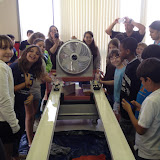
Gotta Regatta Raingutter Race: Seminole Ridge HS physics students were challenged to make the fastest ferry for a Ping-Pong passenger. Using limited supplies teams had to design and build a boat that travels across a container of water.
Third Place: US Kinsey/Palmview Elementary - 13 seconds Second Place: Pierce Hammock Elementary - (tied) 11.2 and 12.5 seconds First Place: New Horizons Elementary - 10 seconds
(Click on the first picture to flip through the Seminole SECME team at "Let's Build Something Together" challenge "Gotta Regatta" rain gutter race during the SECME engineering Olympiad for elementary students on Saturday, February 11, 2012)
The SECME program for the School District of Palm Beach County hosted its engineering Olympiad for elementary school children on Saturday, February 11th. In addition to students bringing and testing their previously constructed projects with them, such as launching water rockets and racing mousetrap powered cars, during the lunch Seminole SECME hosted a special on-site "Let's Build Something Together" challenge for them. Last year, it was the Design Squad pop-fly challenge. This year, it is the Gotta Regatta Raingutter Race. We challenged 51 teams of nearly seven hundred students to make the fastest ferry for a Ping-Pong passenger! Design and build a boat that travels across a container of water.
Thank you to our first-mate sponsors Lowe's Home Improvement store #1962, the Marine Industries Association of Palm Beach County, and the Hawks of Seminole Ridge SECME: Captain Caitlin Miller, Kristen Cousins, Raychell Harris, and Ronit Liberman!
WHY: Calling all Engineers! Test your skills with hands-on, friendly competitions and interactive activities in our Design Nation: Build It Challenge. Use teamwork to create a paper table sturdy enough to hold stacks of books and more engineering feats.
And see the traveling exhibit "K’NEX: Building Thrill Rides". Explore the science, math and technology behind hair-raising amusement park thrill rides. The display models will range from a 10-foot-tall roller coaster, to a 6-foot Ferris wheel all made from K'NEX regular and micro parts. The realistic actions of the models will bring scientific and engineering concepts to life for visitors, who will be able to conduct simple experiments to explore physical forces such as potential and kinetic energy, and linear and rotational motion.
Happily, children won’t have to leave their on-site creations behind – instead, they can purchase their designs, with pricing based on a Weigh & Pay model. The Explore Store will also have K’NEX sets on sale for aspiring young engineers and architects.
HOW MUCH: Special Admission price: show you are with SECME for a reduced rate. Wear your SECME tshirt or show your SECME membership card are received a discounted group rate which is $10 for exhibits or $14 for exhibits and one classic 45-minute IMAX film. Teachers/Coaches/Coordinators: FREE admission with membership to museum. See attached form!
WHERE: Museum of Discovery and Science & AutoNation IMAX® Theater 401 S.W. Second Street Fort Lauderdale, FL 33312 954.713.0915 www.mods.org
Let's Build Something Together challenge PROTOTYPE Raingutter Regatta challenge
---
A boat is a watercraft design to float. Types of boats range from canoes to catamarans to cargo carriers. We challenge your team to make a boat that can ferry a Ping-Pong passenger!
MATERIALS PER TEAM • Masking tape • 3–5 paint stirrers • 3 playing cards • 1 plastic sandwich bags • 2 rubber bands • 2 drinking straws • 1 Ping—Pong ball • 3 oz paper cup
BRAINSTORM AND DESIGN Look at your Materials and think about the questions below. Then sketch your ideas on a piece of paper or in your design notebook.
1.How will you make a boat that floats well enough to support a heavy load without sinking? 2.Should your boat be a platform (e.g., a raft or barge) or an open boat (e.g., a rowboat or canoe)? 3.What's the best way to make your boat waterproof? 4.How big do you need to make your boat?
Build, Test, Evaluate & Redesign Use the Materials to build your boat. Then test it by floating it in a container of water and adding washers, one at a time. When you test, your design may not work as planned. When engineers solve a problem, they try different ideas, learn from mistakes, and try again. The steps they use to arrive at a solution is called the design process. Study the problems and then redesign. For example, if the boat: •sinks easily—Increase its ability to float. When you set your boat in water, notice how it sinks down a bit, pushing aside some water. The water pushes right back, pressing on the boat's bottom and sides. The force from these pushes is called buoyancy. To change your boat's buoyancy, experiment with the boat's width and the height of its sides. •leaks a lot—See if the straws are filling with water or if the plastic wrap is separating. •tips easily—Check how near the weights are to each other. A boat can get tippy when one part is heavier than another.
YOUR CHALLENGE Build a car that goes really far, really fast. Oh, by the way, your power source is a rubber band, and your car can only have two wheels. Start your engines!
MATERIALS (PER CAR) •5 x 6—inch piece of corrugated cardboard (cut so the holes from the corrugation are visible along the long edge) •Ruler •Scissors •1 wooden skewer (Use the thinnest available skewers. These probably will be 1/8 of an inch thick.) •Tape (masking or duct) •2 faucet washers (Size: 1/4—inch Large) •2 CDs •Poster putty (1/4 package) •1 rubber band •Pencils, pens, or markers BUILD 1.Notch the body. Cut a notch in the center of the five—inch side of the cardboard. Make the notch 2 inches wide and 1 1/2—inches deep. Throw away the piece you've cut out. 2.Make the axle. Slide the skewer through the cardboard, close to the outer edge. Make sure the axle sticks out the same amount from each side of the body. When we made ours, the skewer didn't always rotate freely. If this happens to you, twist it until the opening stretches. 3.Modify the axle. Find where the skewer goes across the notch. In the middle of this section, wrap a small piece of tape to make a "catch" for the rubber band. Try twisting the tape that is sticking up to make sure the catch is thick enough to hold the rubber band. 4.Assemble the wheels. Hold a washer in the center hole of a CD. Slide the washer and CD onto the axle, leaving lots of room between the CD and cardboard. Put poster putty on each side of the washer to join the CD, washer, and axle tightly together—REALLY TIGHTLY. The wheel and axle should now rotate together. Make the second wheel the same way. 5.Attach the rubber band. Tape one end of a rubber band to the cardboard at the end opposite the axle. 6.Power your car. Wrap the unattached end of the rubber band over the catch. Turn the axle several times. You've given the rubber band potential (stored) energy. When it unwinds, this potential energy is transformed into kinetic (motion) energy, and the axle spins. The more you wind the rubber band, the more energy is available for your car's wheels—and the farther and faster your car goes. TEST It's off to the races. Set your car on the floor, rubber band side down. What happens when you let your car go? When we made ours, our wheels didn't always turn freely. If this happens to you, make sure the catch isn't hitting the cardboard when the axle spins. Also, check to make sure the rubber band isn't jamming itself against the cardboard. We found that wrapping the rubber band more carefully usually solved the problem, but you can also create more space for the rubber band by making the notch just a little wider.
REDESIGN You've just built a prototype, which is an early version of a product. Prototypes help engineers understand a product's strengths and weaknesses and how it might be improved. Thinking about your car, try to come up with some ways to make it perform even better. You can also redesign it for new challenges, like making it work on sand or thick carpet. Brainstorm ideas, revise your design, and then build and test it.
INSIDE THE ENGINEERING Your car is powered by a rubber band, but most cars use gasoline. The average car gets around 20 miles per gallon, but gasoline is an expensive, limited source of energy that pollutes. Many people want an alternative fuel source that is more affordable, more efficient, and more environmentally friendly. In 2006, two engineering students created the MIT Vehicle Design Summit—challenging students from around the world to build cars that didn't use gasoline and could get the equivalent of 500 miles per gallon... and they did it! One car used a hydrogen fuel cell (a device that converts hydrogen and oxygen into electricity.) Another combined human power and solar power, while a third was entirely electric. A fourth car used biodiesel, an environmentally friendly fuel that can be made from grass, corn, or soybeans. Today you're working with rubber bands, but tomorrow, who knows!

 http://pbskids.org/designsquad/pdf/parentseducators/dsn_nasa_missionsolarsystem_complete.pdf