The White House
Office of the Press Secretary
For Immediate Release November 23, 2009
Remarks by the President on the "Education To Innovate" Campaign
South Court Auditorium, Dwight D. Eisenhower Executive Office Building
11:46 A.M. EST
THE PRESIDENT: Thank you. I am extraordinarily excited to have you all here today. A couple of special acknowledgements I want to make -- first of all, two of my outstanding Cabinet members: Secretary Arne Duncan, our Education Secretary; and Secretary Steven Chu, who is our Energy Secretary. They are both doing outstanding work each and every day.
I want to acknowledge Representative Eddie Bernice Johnson, who is from Texas, and she is one of the members of our Science and Technology Committee and doing outstanding work. NASA Administrator Charlie Bolden is in the house. Where's Charlie? There he is, right there in front. NSF Director Dr. Arden Bement is here, right there. Dr. John Holdren, my Science and Technology Advisor -- where's John? Right there. Melody Barnes, our Domestic Policy Council chair or head, director. (Laughter.) Director.
And then we've got some students from -- some wonderful students from some wonderful schools: Oakton High School in Vienna, Virginia; Longfellow Middle School in Fairfax, Virginia; the Washington Mathematics Science Technology Public Charter High School here in D.C., and the Herndon High School in Herndon, Virginia. Welcome, everybody. (Applause.)
Now, the students from Oakton High School are going to be demonstrating the "Cougar Cannon," designed to scoop up and toss moon rocks. I am eager to see what they do -- for two reasons. As President, I believe that robotics can inspire young people to pursue science and engineering. And I also want to keep an eye on those robots, in case they try anything. (Laughter.)
It's an honor to be here and to be joined by Sally Ride, the first American woman in space. Sally. (Applause.) This is a person who's inspired a generation of girls and boys to think bigger and set their sights higher. I want to thank NASA and Charlie for providing the interactive globe -- an innovative and engaging way of teaching young people about our world.
Welcome, Mythbusters, from Discovery Channel. Where are they? There they are. (Applause.) I hope you guys left the explosives at home. (Laughter.) And finally, allow me to thank the many leaders here today who've agreed to be part of this historic effort to inspire and educate a new generation in math and science.
We live in a world of unprecedented perils, but also unparalleled potential. Our medical system holds the promise of unlocking new cures -- but it's attached to a health care system that's bankrupting families and businesses and our government. The sources of energy that power our economy are also endangering our planet. We confront threats to our security that seek to exploit the very openness that is essential to our prosperity. And we face challenges in a global marketplace that link the trader to Wall Street to the homeowner on Main Street, to the office worker in America to the factory worker in China -- an economy in which we all share in opportunity, but we also share, unfortunately, in crisis.
The key to meeting these challenges -- to improving our health and well-being, to harnessing clean energy, to protecting our security, and succeeding in the global economy -- will be reaffirming and strengthening America's role as the world's engine of scientific discovery and technological innovation. And that leadership tomorrow depends on how we educate our students today, especially in those fields that hold the promise of producing future innovations and innovators. And that's why education in math and science is so important.
Now the hard truth is that for decades we've been losing ground. One assessment shows American 15-year-olds now rank 21st in science and 25th in math when compared to their peers around the world. And this isn't news. We've seen worrying statistics like this for years. Yet, time and again, we've let partisan and petty bickering stand in the way of progress. And time and again, as a nation, we've let our children down.
So I'm here and you are here because we all believe that we can't allow division and indifference to imperil our position in the world. It's time for all of us -- in Washington and across America -- to take responsibility for our future.
And that's why I'm committed to moving our country from the middle to the top of the pack in science and math education over the next decade. To meet this goal, the Recovery Act included the largest investment in education in history while preventing hundreds of thousands of educators from being fired because of state budget shortfalls. Under the outstanding leadership of Arne Duncan, we've launched a $4 billion Race to the Top fund, one of the largest investments in education reform in history.
And through the Race to the Top, states won't just be receiving funding, they'll have to compete for funding. And in this competition, producing the most innovative programs in math and science will be an advantage. In addition, we are challenging states to improve achievement by raising standards, using data to better inform decisions, and taking new approaches to turn around struggling schools. And because a great teacher is the single most important factor in a great education, we're asking states to focus on teacher effectiveness and to make it possible for professionals -- like many of the people in this room -- to bring their experience and enthusiasm into the classroom.
But you are here because you know the success we seek is not going to be attained by government alone. It depends on the dedication of students and parents, and the commitment of private citizens, organizations, and companies. It depends on all of us. That's why, back in April, at the National Academy of Sciences, I issued a challenge: to encourage folks to think of new and creative ways of engaging young people in science and engineering. And we are here because the leaders in this room answered that call to action.
Today, we are launching the "Educate to Innovate" campaign, a nationwide effort to help reach the goal this administration has set: moving to the top in science and math education in the next decade. We've got leaders from private companies and universities, foundations and non-profits, and organizations representing millions of scientists, engineers, and teachers from across America. The initial commitment of the private sector to this campaign is more than $260 million –- and we only expect the campaign to grow.
Business leaders from Intel, Xerox, Kodak, and Time Warner Cable are teaming up with Sally Ride, and the Bill and Melinda Gates Foundation, as well as the Carnegie Corporation, to find and replicate successful science, math, and technology programs all across America. Sesame Street has begun a two-year initiative to teach young kids about math and science. And Discovery Communications is going to deliver interactive science content to 60,000 schools reaching 35 million students.
These efforts extend beyond the classroom. Time Warner Cable is joining with the Coalition for Science After School and FIRST Robotics -- the program created by inventor Dean Kamen, which gave us the "Cougar Cannon" -- to connect one million students with fun after-school activities, like robotics competitions. The MacArthur Foundation and industry leaders like Sony are launching a nationwide challenge to design compelling, freely available, science-related video games. And organizations representing teachers, scientists, mathematicians, and engineers -- joined by volunteers in the community -- are participating in a grassroots effort called "National Lab Day" to reach 10 million young people with hands-on learning.
Students will launch rockets, construct miniature windmills, and get their hands dirty. They'll have the chance to build and create -- and maybe destroy just a little bit -- (laughter) -- to see the promise of being the makers of things, and not just the consumers of things.
The administration is participating as well. We've already had a number of science-focused events with young people at the White House, including Astronomy Night a few weeks ago. The National Science Foundation and the Department of Energy, under the leadership of a terrific scientist, Steven Chu, have launched an innovative -- an initiative to inspire tens of thousands of students to pursue careers in clean energy.
And today, I'm announcing that we're going to have an annual science fair at the White House with the winners of national competitions in science and technology. If you win the NCAA championship, you come to the White House. Well, if you're a young person and you've produced the best experiment or design, the best hardware or software, you ought to be recognized for that achievement, too. Scientists and engineers ought to stand side by side with athletes and entertainers as role models, and here at the White House we're going to lead by example. We're going to show young people how cool science can be.
Through these efforts, we're going to expand the scope and scale of science and math education all across America. And we're going to expand opportunities for all our young people -- including women and minorities who too often have been underrepresented in scientific and technological fields, but who are no less capable of succeeding in math and science and pursuing careers that will help improve our lives and grow our economy. I also want to note that this is only the beginning. We're going to challenge the private sector to partner with community colleges, for example, to help train the workers of today for the jobs of tomorrow, even as we make college more affordable -- so that, by 2020, America once again leads the world in producing college graduates.
Now, I have to say to the young people who are here, we can't let students off the hook. In the end, the success of this campaign depends on them. But I believe strongly that America's young people will rise to the challenge if given the opportunity -- and given a little bit of a push. We've got to work together to create those opportunities, because our future depends on it.
And I just want to mention the importance not only of students but also of parents. You know, I was in Asia, I think many of you are aware, for a week, and I was having lunch with the President of South Korea, President Lee. And I was interested in education policy -- they've grown enormously over the last 40 years. And I asked him, what are the biggest challenges in your education policy? He said, the biggest challenge that I have is that my parents are too demanding. (Laughter.) He said, even if somebody is dirt poor, they are insisting that their kids are getting the best education. He said, I've had to import thousands of foreign teachers because they're all insisting that Korean children have to learn English in elementary school. That was the biggest education challenge that he had, was an insistence, a demand from parents for excellence in the schools.
And the same thing was true when I went to China. I was talking to the mayor of Shanghai, and I asked him about how he was doing recruiting teachers, given that they've got 25 million people in this one city. He said, we don't have problems recruiting teachers because teaching is so revered and the pay scales for teachers are actually comparable to doctors and other professions.
That gives you a sense of what's happening around the world. There is a hunger for knowledge, an insistence on excellence, a reverence for science and math and technology and learning. That used to be what we were about. That's what we're going to be about again.
And I have to say that this doesn't get a lot of focus. Not once was I asked about education policy during my trip by the press. And oftentimes events like this get short shrift. They're not what's debated on cable. But this is probably going to make more of a difference in determining how well we do as a country than just about anything else that we do here.
Everyone in this room understands how important science and math can be. And it goes beyond the facts in a biology textbook or the questions on an algebra quiz. It's about the ability to understand our world: to harness and train that human capacity to solve problems and think critically, a set of skills that informs the decisions we make throughout our lives.
So, yes, improving education in math and science is about producing engineers and researchers and scientists and innovators who are going to help transform our economy and our lives for the better. But it's also about something more. It's about expanding opportunity for all Americans in a world where an education is the key to success. It's about an informed citizenry in an era where many of the problems we face as a nation are, at root, scientific problems. And it's about the power of science to not only unlock new discoveries, but to unlock in the minds of our young people a sense of promise, a sense that with some hard work -- with effort -- they have the potential to achieve extraordinary things.
This is a difficult time in our country, and it would be easy to grow cynical and wonder if America's best days are behind us -- especially at a time of economic uncertainty, especially when we've seen so many, from Wall Street to Washington, fail to take responsibility for so long. But I believe we have an opportunity now to move beyond the failures of the recent past and to recapture that spirit of American innovation and optimism.
This nation wasn't built on greed. It wasn't built on reckless risk. It wasn't built on short-term gains and short-sighted policies. It was forged on stronger stuff, by bold men and women who dared to invent something new or improve something old -- who took big chances on big ideas, who believed that in America all things are possible. That's our history. And, if we remain fixed on the work ahead, if we build on the progress we've made today, this is going to be our legacy as well.
So, with that, just as proof of the extraordinary promise of American young people, I'd like to invite Steven Harris and Brian Hortelano from Oakton High School to come up here and demonstrate what their team has built. And it's flashing so far. I don't see it whirling. (Laughter.) Where are they? Give them a big round of applause. (Applause.)
END
12:03 P.M. EST

Monday, November 23, 2009
Sunday, November 22, 2009
Saturday, November 21, 2009
Go Hawk Heros!
Seminole SECME and National Honor Society students at Seminole Ridge hosted a blood drive Tuesday, November 17, 2009. Our theme “GIVE BLOOD—IT’S NOT ROCKET SCIENCE” spotlighted students’ achievement in science, tech, engineering, and math (STEM) classes.
Florida's Blood Centers donates ~$20 per unit of blood collected to scholarship assistance for students attending colleges, institutions, and technical centers. And for every pint of blood donated, SECME students launched a water bottle rocket—a two-liter soda bottle filled with compressed air and water. We collected 165 pints, launched 200 rockets, saving almost 500 lives and raising over $3000. Go Hawk Heroes!
As SECME students launched hydro rockets into suborbital flight, their names orbited high overhead, part of NASA’s latest shuttle mission STS-129. Last spring, SECME co-captain Aleen Touma lead the collection of the Class of 2010 names. Seminole Ridge joined with more than 500 other schools worldwide to sign posters for Student Signatures in Space, sponsored by NASA and Lockheed Martin.
Participating schools received Embrace Space posters for student signing, and Lockheed Martin scanned their signatures onto a disk flown aboard space shuttle Atlantis. They will be returned for permanent display along with a flight certificate and a photo of the mission crew.
If you would like more information, please contact Seminole SECME school coordinator Erich Landstrom at (561) 422-2600.
Florida's Blood Centers donates ~$20 per unit of blood collected to scholarship assistance for students attending colleges, institutions, and technical centers. And for every pint of blood donated, SECME students launched a water bottle rocket—a two-liter soda bottle filled with compressed air and water. We collected 165 pints, launched 200 rockets, saving almost 500 lives and raising over $3000. Go Hawk Heroes!
As SECME students launched hydro rockets into suborbital flight, their names orbited high overhead, part of NASA’s latest shuttle mission STS-129. Last spring, SECME co-captain Aleen Touma lead the collection of the Class of 2010 names. Seminole Ridge joined with more than 500 other schools worldwide to sign posters for Student Signatures in Space, sponsored by NASA and Lockheed Martin.
Participating schools received Embrace Space posters for student signing, and Lockheed Martin scanned their signatures onto a disk flown aboard space shuttle Atlantis. They will be returned for permanent display along with a flight certificate and a photo of the mission crew.
If you would like more information, please contact Seminole SECME school coordinator Erich Landstrom at (561) 422-2600.


Friday, November 20, 2009
STEMinar at Seminole Ridge High
S.T.E.M.inar at Seminole Ridge High School

Saturday, December 12, 2009
8:30 am – 1:00 pm
Attention: SECME students and school coordinators!
Join master teachers, proud parents and creative community engineers to work on Olympiad projects. Build and break bridges; blast off bottle rockets; blueprint your banners; and battle in the brain bowl!
Register online at
http://tiny.cc/m9vDR
Email questions to Erich Landstrom at SeminoleSECME [at] gmail [dot] com
Please bring any existing Olympiad submission which you would like to receive assistance. Bring any necessary supplies (such as balsa wood, glue, etc.) for projects that you want to start that day.
Directions to Seminole Ridge High: Travel west on Southern Blvd. (SR 80, or Route 441), or Okeechobee Blvd to Seminole Pratt Whitney Road. Turn north. School on west, across from Callery Judge Grove, before Winn-Dixie plaza.


Saturday, December 12, 2009
8:30 am – 1:00 pm
Attention: SECME students and school coordinators!
Join master teachers, proud parents and creative community engineers to work on Olympiad projects. Build and break bridges; blast off bottle rockets; blueprint your banners; and battle in the brain bowl!
Register online at
http://tiny.cc/m9vDR
Email questions to Erich Landstrom at SeminoleSECME [at] gmail [dot] com
Please bring any existing Olympiad submission which you would like to receive assistance. Bring any necessary supplies (such as balsa wood, glue, etc.) for projects that you want to start that day.
Directions to Seminole Ridge High: Travel west on Southern Blvd. (SR 80, or Route 441), or Okeechobee Blvd to Seminole Pratt Whitney Road. Turn north. School on west, across from Callery Judge Grove, before Winn-Dixie plaza.

Thursday, November 19, 2009
Business Bash & Academy Open House 2009
 Taylor Ramey with the Seminole SECME table at the Bash 2009
Seminole Ridge High School hosted its annual Business Bash on Thursday, November 19 at the school campus. Business owners and community organizations will have the opportunity to learn how the school can support their business, and in turn, how businesses can support the school.
 Junior Cindy Dosch explains water bottle rocketry at the Bash.
 The United States is struggling with a serious shortage of technology-based professionals, including engineers, scientists and mathematicians. SECME has proven to be highly successful in helping educationally disadvantaged students excel in math and science so they can become the technology-based professionals that America needs. Industry knows it can count on SECME for a well-trained STEM workforce.
 Prospective students for the Class of 2014 could operate the VEX robot during the Academy Open House
The event began at 5 p.m. in the gymnasium with a tour of academy, academic, fine arts and athletic displays from the classes, clubs and sports. A reception in the media center followed at 6 p.m., and the evening concluded with an academy program presentation at 6:45 p.m. in the auditorium. Join SECME! Get Smart! Have Fun!
For more event information, contact academy coordinator John Walker at (561) 422-2600 or walkerjo[at]palmbeach[dot]k12[dot]fl[dot]us.
Tuesday, November 17, 2009
Blood and Water
 Give Blood -- It's Not Rocket Science
Seminole Ridge Community High School

Seminole SECME and the Seminole Ridge National Honor Society students hosted a blood drive Tuesday, November 17. Our theme “GIVE BLOOD—IT’S NOT ROCKET SCIENCE” spotlighted students’ achievement in science, tech, engineering, and math (STEM) classes. Florida's Blood Centers donate approximately $20 per unit of blood collected to the Scholarship Assistance Foundation to support tuition assistance. We collected 165 pints, and for every pint of blood donated, SECME students launched a water bottle rocket—a two-liter soda bottle filled with compressed air and water.
Designing, building, and flying a water bottle rocket ignites students’ minds with a real-world application of STEM. Students manipulate and control variables. Math and science studies are necessary to complete the process—the physics of Newton’s laws of motion, the projectile motion, polynomial equations for freefall calculations, parabolic paths, and the practice of true engineering. These are the tools that an engineer uses to solve a problem. Go Hawk Heroes!
Monday, November 16, 2009
These Hawks are Going to Fly! Space Shuttle Launch Today Brings Seminole's Class of 2010 Signatures Into Orbit
 Shuttle carrying Palm Beach County student signatures.
Read about it in the South Florida Sun-Sentinel newspaper education weblog.
----- ----- ----- ----- ----- ----- ----- ----- ----- ----- ----- -----
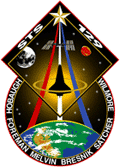 STS-129
Launch Time: Monday, November 16, 2:28 p.m. EST
Launch Vehicle: Shuttle Atlantis • ISS ULF 3
Launch Site: LC-39A, Kennedy Space Center, Florida
STS-129 will be the 31st U.S. mission to the International Space Station and will return Space Station crew member Nicole Stott to Earth.
Space shuttle Atlantis will deliver components including two spare gyroscopes, two nitrogen tank assemblies, two pump modules, an ammonia tank assembly and a spare latching end effector for the station's robotic arm to the International Space Station.
And, most excitingly, our Seminole Senior's Student Signatures in Space poster has been manifested to fly on STS-129. Last spring, SECME co-captain Aleen Touma lead the collection of the Class of 2010 names as Seminole Ridge High joined with more than 500 other schools worldwide to sign posters for Student Signatures in Space (S3), sponsored by NASA and Lockheed Martin.

S3 began in 1997 as a way to draw kids into space studies by giving them a personal connection to space. Participating schools receive large posters for students to sign and, after schools return the posters to Lockheed Martin, their signatures are scanned onto a disk.

After the signatures return from space, the signed poster will be returned for permanent display at Seminole Ridge, along with a flight certificate and a picture of the crew that carried the signatures into space. It usually takes about 8 to 12 weeks after the mission concludes to get all posters returned.

Seminole SECME school coordinator Erich Landstrom said, “Our goal with Student Signatures in Space is to spark kids’ interest in school and to give them a personal connection to the wonders of the universe. In SECME we use space-related activities to inspire students to continue the stellar work of today’s space program, and to prepare young people for careers in science, technology, engineering and mathematics.”
For more information about the STS-129 mission and its crew, visit:
NASA at http://www.nasa.gov/shuttle, and
SpaceFlight Now at http://www.spaceflightnow.com/shuttle/sts129/
Sunday, November 15, 2009
Saturday, November 14, 2009
Friday, November 13, 2009
Win Prizes! NASA's landmark discovery of water ice on the Moon raises stakes for Google $30M X Prize
A team of scientists from NASA announced that significant amounts of water ice have been found at the Moon’s South Pole. This landmark finding, achieved through analysis of the material blasted from the lunar surface as part of the Lunar Crater Observation and Sensing Satellite (LCROSS) mission, provides a great boon to an international community of scientists, engineers, and entrepreneurs cultivating a new era of lunar exploration. The announcement also builds upon the groundbreaking research conducted by both NASA and the Indian Space Research Organization, which recently revealed trace amounts of water distributed across the Moon’s surface, previously thought to be more dehydrated that the driest deserts of Earth.
The confirmation of the presence of water ice on the surface of the Moon is a game-changing discovery for space exploration. The Moon, already a hotly pursued destination of space agencies and private companies from around the world, becomes even more desirable with today’s news. With ready supplies of ice, future robotic spacecraft or human astronaut crews could generate not only drinking water but also gaseous hydrogen and oxygen —excellent propellants that could be used for further space exploration beyond the Moon.
The discovery also provides new support for a private race to return to the Moon. The Google Lunar X PRIZE, a $30 million incentive prize created and operated by the X PRIZE Foundation, challenges privately funded teams from around the globe to send robots to explore the lunar surface and return high resolution video and imagery back to the Earth. The prize program includes a Water Detection Bonus, which pays additional prize money to teams that use robots on the lunar surface to provide confirmation of the presence of water ice. Until today’s announcement, it was uncertain if this bonus would be obtainable.
“The presence of significant quantities of ice on the lunar surface catapults the Moon from an interesting waypoint to a critical launching pad for humanity’s exploration of the cosmos,” said X PRIZE CEO and Chairman Peter Diamandis. “We’re entering a new era of lunar exploration – ‘Moon 2.0,’ in which an international group of companies and governments will use the ice and other unique resources of the Moon to help us expand the sphere of human influence, and to help us monitor and protect the Earth.”
The success of the LCROSS mission is just the latest in a recent string of lunar probes. In the past two years, NASA, the Indian Space Research Organization, the Japanese Aerospace Exploration Agency, and China’s National Space Administration have each placed satellites in orbit around the Moon. With more than twenty teams from eleven countries registered to compete in the Google Lunar X PRIZE, we may be only a few years away from the first private lunar mission, and the first spacecraft to explore the lunar surface since 1976.
“We congratulate the team at NASA and the brilliant engineers and scientists at the other space agencies who have made the discovery announced today possible,” said X PRIZE Foundation Senior Director for Space Prize William Pomerantz. “We’re confident that these exciting findings will inspire a new generation of lunar pioneers to continue to transcend the boundaries of what was previously believed to be possible.”
ABOUT THE X PRIZE FOUNDATION
The X PRIZE Foundation is an educational nonprofit prize institute whose mission is to create radical breakthroughs for the benefit of humanity. In 2004, the Foundation captured world headlines when Burt Rutan, backed by Microsoft co-founder Paul Allen, built and flew the world’s first private vehicle to space to win the $10 million Ansari X PRIZE. The Foundation has since launched the $10 million Archon X PRIZE for Genomics, the $30 million Google Lunar X PRIZE, and the $10 million Progressive Insurance Automotive X PRIZE. The Foundation is creating and conducting competitions in four prize groups: Exploration (Space and Oceans), Life Sciences, Energy & Environment, and Education & Global Development. The Foundation is widely recognized as the leader in fostering innovation through competition. For more information, please visit www.xprize.org.
ABOUT THE GOOGLE LUNAR X PRIZE
The $30 million Google Lunar X PRIZE is an unprecedented international competition that challenges and inspires engineers and entrepreneurs from around the world to develop low-cost methods of robotic space exploration. The $30 million prize purse is segmented into a $20 million Grand Prize, a $5 million Second Prize, and $5 million in bonus prizes. To win the Grand Prize, a team must successfully soft land a privately funded spacecraft on the Moon, explore the lunar surface by moving at least 500 meters, and transmit a specific set of video, images, and data back to the Earth. The Grand Prize is $20 million until December 31st, 2012; thereafter it will drop to $15 million until the prize expires on December 31st, 2014. For more information about the Google Lunar X PRIZE, please visit www.googlelunarxprize.org.
The confirmation of the presence of water ice on the surface of the Moon is a game-changing discovery for space exploration. The Moon, already a hotly pursued destination of space agencies and private companies from around the world, becomes even more desirable with today’s news. With ready supplies of ice, future robotic spacecraft or human astronaut crews could generate not only drinking water but also gaseous hydrogen and oxygen —excellent propellants that could be used for further space exploration beyond the Moon.
The discovery also provides new support for a private race to return to the Moon. The Google Lunar X PRIZE, a $30 million incentive prize created and operated by the X PRIZE Foundation, challenges privately funded teams from around the globe to send robots to explore the lunar surface and return high resolution video and imagery back to the Earth. The prize program includes a Water Detection Bonus, which pays additional prize money to teams that use robots on the lunar surface to provide confirmation of the presence of water ice. Until today’s announcement, it was uncertain if this bonus would be obtainable.
“The presence of significant quantities of ice on the lunar surface catapults the Moon from an interesting waypoint to a critical launching pad for humanity’s exploration of the cosmos,” said X PRIZE CEO and Chairman Peter Diamandis. “We’re entering a new era of lunar exploration – ‘Moon 2.0,’ in which an international group of companies and governments will use the ice and other unique resources of the Moon to help us expand the sphere of human influence, and to help us monitor and protect the Earth.”
The success of the LCROSS mission is just the latest in a recent string of lunar probes. In the past two years, NASA, the Indian Space Research Organization, the Japanese Aerospace Exploration Agency, and China’s National Space Administration have each placed satellites in orbit around the Moon. With more than twenty teams from eleven countries registered to compete in the Google Lunar X PRIZE, we may be only a few years away from the first private lunar mission, and the first spacecraft to explore the lunar surface since 1976.
“We congratulate the team at NASA and the brilliant engineers and scientists at the other space agencies who have made the discovery announced today possible,” said X PRIZE Foundation Senior Director for Space Prize William Pomerantz. “We’re confident that these exciting findings will inspire a new generation of lunar pioneers to continue to transcend the boundaries of what was previously believed to be possible.”
ABOUT THE X PRIZE FOUNDATION
The X PRIZE Foundation is an educational nonprofit prize institute whose mission is to create radical breakthroughs for the benefit of humanity. In 2004, the Foundation captured world headlines when Burt Rutan, backed by Microsoft co-founder Paul Allen, built and flew the world’s first private vehicle to space to win the $10 million Ansari X PRIZE. The Foundation has since launched the $10 million Archon X PRIZE for Genomics, the $30 million Google Lunar X PRIZE, and the $10 million Progressive Insurance Automotive X PRIZE. The Foundation is creating and conducting competitions in four prize groups: Exploration (Space and Oceans), Life Sciences, Energy & Environment, and Education & Global Development. The Foundation is widely recognized as the leader in fostering innovation through competition. For more information, please visit www.xprize.org.
ABOUT THE GOOGLE LUNAR X PRIZE
The $30 million Google Lunar X PRIZE is an unprecedented international competition that challenges and inspires engineers and entrepreneurs from around the world to develop low-cost methods of robotic space exploration. The $30 million prize purse is segmented into a $20 million Grand Prize, a $5 million Second Prize, and $5 million in bonus prizes. To win the Grand Prize, a team must successfully soft land a privately funded spacecraft on the Moon, explore the lunar surface by moving at least 500 meters, and transmit a specific set of video, images, and data back to the Earth. The Grand Prize is $20 million until December 31st, 2012; thereafter it will drop to $15 million until the prize expires on December 31st, 2014. For more information about the Google Lunar X PRIZE, please visit www.googlelunarxprize.org.
Subscribe to:
Posts (Atom)