Thursday, December 22, 2011

Rest, Relax and Recharge

Happy New Year of the Dragon 2012!


Captains Cindy Dosch (2010-2011), Caitlin Miller (2011-2012), and Brian Bartels (2010-2011)

Monday, December 19, 2011

Adopt-A-Classroom and Wells Fargo Get Into The Holiday Spirit Helping Classrooms


At this Holiday Season, a generous partnership is putting much needed dollars into the classroom. The School District has partnered with Adopt-A-Classroom, a national 501(c)(3) nonprofit organization, in efforts to increase community support and donations for local classrooms. Wells Fargo is sponsoring the campaign in challenge and matching grant dollars. Thanks to the generous donation, Wells Fargo has helped raise over $125,000 for Palm Beach County schools, providing for much needed materials and supplies in the classroom.

Adopt-A-Classroom is the nation’s only nonprofit organization that enables donors to identify and make a donation to a specific classroom. Donations are tax deductible and teachers receive 100% of funds donated. Teachers have full discretion to budget the expenditure and purchase classroom materials that meet their students’ specific needs. The best part is that donors get to see exactly what the teacher purchased.

Grassy Waters Elementary School in West Palm Beach was recently awarded one of the Wells Fargo $5,000 Challenge grants. According to Grassy Waters Principal Amy Wilkinson, “Adopt-A-Classroom and Wells Fargo have been extremely beneficial to all our teachers and students. It’s enabled the teachers to get many of the materials and supplies that they need to become better teachers and our students love the new supplies.” Lisa Park, Senior Relationship Manager, Wells Fargo At Work believes, “The Adopt-A-Classroom program has been tremendous. What a gift to see how we have been able to help the classrooms, and most importantly get the extra school supplies and all the things students need to be more successful in their day-to-day endeavors in school.”

Since 1998, Adopt-A-Classroom has raised more than $16 million on behalf of classrooms, impacting more than one million students in the United States. “Anyone can easily make a difference for a teacher and a classroom of children by using our program to make a donation,” said James Rosenberg, Founder and Executive Director of Adopt-A-Classroom. “There is no easier way to donate to a classroom in such a transparent and accountable way. We are thrilled to partner with the School District of Palm Beach County in order to bring much-needed funds into classrooms.”

“Wells Fargo invests in building strong communities, and our matching grant to Adopt-A-Classroom goes right to the source: the classrooms where our teachers teach and where our children learn,” said Frank Newman, Wells Fargo’s regional president for South Florida. “At a time when county funds are being scaled back, we need to contribute to public education and inspire others to do the same.”

To make a donation to Seminole Ridge SECME, go to http://www.tinyurl.com/AdoptSeminoleSECME and click on Donate $ button to give $2, $20, or $200. Donations can be made by credit card or check.

About The School District of Palm Beach County
The School District of Palm Beach County, Florida, is the eleventh largest in the nation and the fifth largest in the state of Florida with 187 schools, serving 174,000 students who speak 141 languages/dialects. The School District has 21,361 employees including 12,480 teachers. Over 37,000 community volunteers provide academic assistance to students through the Volunteers in Public Schools (VIPS) Program. Additionally, approximately 1,000 business partners offer resources to support increased student achievement. For more information please visit www.palmbeachschools.org .

About Adopt-A-Classroom
Adopt-A-Classroom is a national, award-winning 501(c)(3) nonprofit organization dedicated to supporting classroom teachers and ensuring all children have equal access to a quality education. Since 1998, the organization has raised over $16 million on behalf of classrooms across America. Donations are tax-deductible and 100% is passed through to the teacher. Teachers have the ability to purchase resources that create a more engaging learning environment and also provide valuable new ways to inspire children about the wonders of learning. To support a classroom, visit www.adoptaclassroom.org .
About Wells Fargo Foundation
Wells Fargo & Company (NYSE: WFC) is a nationwide, diversified, community-based financial services company with $1.3 trillion in assets. Founded in 1852 and headquartered in San Francisco, Wells Fargo provides banking, insurance, investments, mortgage, and consumer and commercial finance through more than 9,000 stores, 12,000 ATMs, the Internet (wellsfargo.com and wachovia.com), and other distribution channels across North America and internationally. We want to help all of our customers succeed financially and create long-term economic growth and quality of life for everyone in our communities. In 2010, the Company invested a record $219 million in grants in 19,000 nonprofits, and team members contributed more than 1.3 million volunteer hours around the country. For more information, please visit: www.wellsfargo.com/about/csr.

Wednesday, December 7, 2011

Never met a scientific illustrator? Meet Carol.

Image of the Week #20, December 5th, 2011:


Original source: Journal of Vertebrate Paleontology 1992 cover illustration of the reconstruction of the skull of Stegosaurus stenops in left lateral view. Ink on paper, by Carol Abraczinskas.

Never met a scientific illustrator? Meet Carol.
by Kalliopi Monoyios at Symbiartic.

Stipple is a pen and ink technique used in scientific illustration that utilizes millions of tiny dots to create areas of shadow and light. This stipple drawing of the skull of Stegosaurus stenops by Carol Abraczinskas appeared on the cover of the Journal of Vertebrate Paleontology in 1992. It’s a favorite teaching tool of Abraczinskas’s because it tests students’ observational skills. One missing dot prevents this illustration from being complete. Can you find it? To check if you got it right, see the original post for an enlarged view of that detail.

Monday, December 5, 2011

Hawks Compete in Gulliver Gateway VEX South Florida Championship

(Click on the first picture to flip through the Gulliver VRC Gateway photostream)
20111204 VRC Gulliver Gateway


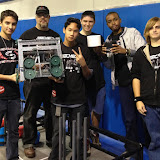
Seminole Ridge SECME students competed in the South Florida Championship of the VEX Robotics Competition (VRC) at Gulliver Preparatory School in Miami on Sunday. VRC Team 1614 consisted of robot drivers sophomore Connor Piegaro and freshman Bert Sivongsay, field scouts junior Kadeem Spencer and sophomore Jesse Mendheim, and programmer Brandon Gearty. To prepare for the competition, the group worked together to design and build a robot (affectionately nicknamed “Iron Dragon”) that could quickly and efficiently solve the specific obstacles and challenges that come with playing the game VEX Gateway.

The goal of Gateway is to attain a higher score than your opponent alliance by scoring barrels and balls in goals, earning bonus points and doubling or negating goals. Two alliances—‘red’ and ‘blue’— are composed of randomly paired teams to partner that compete during a twenty-second autonomous period followed by two minutes of driver-controlled play. The allies work both independently in the isolation zones behind the Gateway, and together in the interaction zone.

The students competed with and against 47 teams from across the state, Melbourne to Miami, from Bradenton to Boca, at the tournament. The Hawks qualified for the quarterfinal’s but were one-and-done during the playoffs. (Their record in the qualifying rounds was 2-4, and just made the playoffs cutoff as team 32). Still, the team’s coach, physics teacher Erich Landstrom, is impressed with the team: “We are building more than robots here - we are shaping our future innovators to positively impact the world around them.”

Each week, Seminole SECME students apply what they’ve learned about science, technology, engineering, and math in order to build these semiautonomous VEX machines. And through the competition students learn an equally important skill set: communication, project management, site management, and composure, because students have to learn to ‘fail faster’: not just how to win. but how to recover from losing. They work together on a variety of challenges and obstacles requiring new problem-solving skills.

Seminole SECME VRC team #1614 raises funds to cover the cost of the robot parts, competition entry fees and transportation expenses by asking the local community for support. Please support Seminole SECME this holiday season and make a matching gift at http://tinyurl.com/AdoptSeminoleSECME . Give $3, $30, or $300 -- all gifts are welcome.

Tuesday, November 29, 2011

Hey, coach! How's your SECME? EOY 2011

Seasons Greetings, PLC Members!

I need to hear from you in the next ten days, by December 10th. But it will take less then 10 minutes to answer 10 questions and complete the mid-year survey. The information is vital to the SECME National Office.

As you know, most school districts are data-driven and the more data the National Office can share the better. This is your time to have a sounding board to share your thoughts and feelings. So please share what's working and what's not working! I promise it will drive and guide future professional development and funding!

Please know you are valued and your hard work is appreciated. Thanks for your time and assistance!

Click here to take survey

Monday, November 28, 2011

20 years, and less than 20 points...

The National Science Foundation (NSF) Act, 42 U.S.C. § 1863 (j) (1) requires the biennial Science and Engineering Indicators (SEI) report to the President and to the Congress by January 15 of every even-numbered year. Since the next report is due out in six weeks, let's review the indicators in the last report (2010).

U.S. data show that the public's level of factual knowledge about science has not changed much over time. Figure 7-8 shows average numbers of correct answers to a series of mostly true-false science questions in different years for which fully comparable data were collected (appendix table 7-8 ).[10] Although performance on individual questions varies somewhat over time (appendix table 7-9 ), overall scores are relatively similar.

CITATION
National Science Board. 2010. Science and Engineering Indicators 2010. Arlington, VA: National Science Foundation (NSB 10-01).


Ah, geez. Over twenty years from 1988 to 2008, we haven't risen twenty percent above the gathering storm. Look at the learning gains - they are mostly small, between 5-10%.

Remember, SEI is factual and policy-neutral; it neither offers policy options nor makes policy recommendations. The indicators included in the report are intended to contribute to the understanding of the current science and engineering environment. The SEI digest draws attention to disturbing trends....

http://www.nsf.gov/statistics/seind10/c7/c7s.htm#sb4

Sunday, November 27, 2011

Mars Rover Curiosity Takes Off

NASA's biggest and most capable Mars rover ever left Earth on Saturday morning in a picture perfect launch from Cape Canaveral. The new rover, named "Curiosity", is due to reach the Red Planet in August 2012.
FULL STORY at
http://science.nasa.gov/science-news/science-at-nasa/2011/26nov_msllaunch/

Wednesday, November 23, 2011

For women and minorities, STEM is the best equal opportunity employer

NEW REPORT FINDS THAT 63 PERCENT OF ASSOCIATE’S DEGREES IN STEM EARN MORE THAN BACHELOR’S DEGREES IN NON-STEM OCCUPATIONS

Study also finds that STEM jobs are among the nation’s most highly-paid and fastest-growing

(Washington, D.C., Oct. 20, 2011) – A new report from the Georgetown University Center on Education and the Workforce shows that 65 percent of Bachelor’s degrees in STEM (science, engineering, technology and mathematics) occupations earn more than Master’s degrees in non-STEM occupations. Similarly, 47 percent of Bachelor’s degrees in STEM occupations earn more than PhDs in non-STEM occupations. Furthermore, even people with only STEM certificates can earn more than people with non-STEM degrees; for instance certificate holders in engineering earn more than Associate’s degree-holders in business and more than Bachelor’s degree-holders in education.

STEM will grow to only 5 percent of all jobs by 2018 and demand for STEM talent is growing even faster outside of traditional STEM occupations. This increasing demand for STEM knowledge, skills and abilities allows many individuals with STEM talent to leave STEM occupations. Students and workers divert from STEM jobs because, while STEM is high-paying, STEM students have access to higher-paying career options.

The report finds that of out of every 100 students with a Bachelor’s degree, 19 graduate with a STEM degree but only eight are working in STEM occupations ten years after graduation.

But it’s not only about money—a major conclusion of the report is that STEM talent winds up outside of STEM occupations because STEM jobs often do not fully satisfy individual social and entrepreneurial interests.

“STEM provides choice for people both immediately after school and at mid-career, allowing people to transition to different and oftentimes more lucrative career pathways, including management and healthcare that provide long-term stability and excellent wages.” says Anthony P. Carnevale, the Center’s director and the report’s lead author.

The report details STEM earnings by occupation, race, sex, and education level, and finds:

For women and minorities, STEM is the best equal opportunity employer.
• For women and minorities, STEM is a good news/bad news story. Women and minorities are underrepresented in STEM.
• But for those who do persist, the pay gap in STEM between women and minorities and white men is smaller in STEM than in any other occupation.

STEM pays more than most jobs at each level of education, and at the graduate level is exceeded only by a small sliver of managerial and healthcare occupations.
• Over 70 percent of STEM workers at the high school or some college level make more than the average for workers in all other occupations at the same education level.

More than two-thirds of Associate’s degree-holders in STEM make more than the average for all Associate’s degree-holders.
• STEM training pays more even if you don’t work in a STEM occupation.
• Workers majoring in STEM in college earn more than all other majors over their lifetimes, even if they work in non-STEM occupations.

Apart from the full national report, STEM contains a state-level analysis of STEM jobs. STEM is available online at http://cew.georgetown.edu/STEM.

The Georgetown University Center on Education and the Workforce is an independent, nonprofit research and policy institute that studies the link between individual goals, education and training curricula, and career pathways.

Tuesday, November 22, 2011

Seminole Ridge 2011 Pathfinder Nominees

Seminole Ridge High School is pleased to announce the 2012 Palm Beach Post Pathfinder Scholarship nominees. Students are nominated in 18 academic, vocational, and athletic categories and ddemonstrate outstanding achievement. The following Pathfinder nominees have also participated in Seminole SECME (or if not in SECME, have been science students of Seminole Ridge SECME school coordinator Mr. Landstrom and have been in a SECME-tized classroom)

Again, congratulations to our Seminole Ridge Seniors who have been nominated for this prestigious award. Please wish them luck and encouragement as they continue through the nomination process.

Art Ronit Liberman

Business Robert Botkin

Forensics/Speech Cash Galko

History/Political Science Julia Frate

Literature Taylor Godfrey

Mathematics Michael Canlas

Reach for Excellence Patrick Eden

Sunday, November 20, 2011

Figure This! On the 12th+11th+10th Day of Christmas

On the first day of Christmas, my true love sends to me a partridge in a pear tree. On the 2nd day, my love sends two turtle doves and a partridge in pear tree. On the 3rd day, three french hens, two turtle doves, and a partridge in pear tree. This pattern continues for nine more days. The remaining gifts, in order of appearance, include colly birds, gold rings, geese, swans, maids, ladies, lords, pipers, and drummers. Figure this! After 12 days, which gift did my true love send the most?

Hint: How many of each gift did I receive on each day?
Get Started: Make a table to organize this information.


Answer in the comments!