Due to scheduling conflicts, Seminole Ridge SECME was not able to attend the VEX workshop and mock competition on Saturday, March 28th at Embry-Riddle Aeronatical University. Information from SECME National on the event was not provide until Wednesday, March 25th (the week of the event), when chaperones and students had already made plans for spring break. Instead, for purposes of final reports on grants we are substituting our presentation demonstration of VEX robotics at the engineering Olympiad for School District of Palm Beach County secondary schools.
Planets, Proportions, and Pottery in Palm Beach County School District
The Seminole Ridge Solar System Scale Model.
Statement I: Project Description
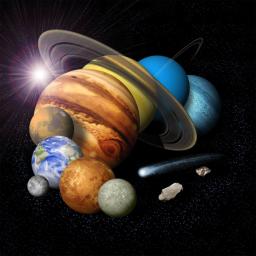
The Seminole Solar System Scale Model is an interdisciplinary exploration of art, science, and math. The model will include multiple displays, each representing one of the naked eye planets, placed at a scaled distance from the first marker – the Sun. The model will encompass the campuses across the Indian Trail Improvement District, starting with the Sun at Seminole Ridge High School, and stretching back to the elementary and middle school through which pupils progressed. The displays will give students, parents, teachers, and community partners a visual understanding of the vast distances spacecraft must travel to explore other regions of the solar system.
In a classroom activity, students relate the concepts of measurement to similarity and proportionality in real-world situations and accurately scale the distance between the Sun and the planets of the solar system. Adapted from NASA teacher guides and the Google Lunar X Prize, students use a basketball to depict Earth’s size. Logically progressing, students are asked how far to place away the Sun and the Moon to accurately represent an eclipse. Within these ratios, students compute a scale model of the solar system. Students next concretely represent those worlds using ceramics. Working with NASA images from unmanned missions as inspiration and for accuracy, student artists use slab and coil methods in construction. They will create textures and pattern in clay as they create relief depictions of topographic features such as continents and craters. And they will explore pottery decorating techniques as they glaze their globes. The “finished” products with explanatory captions and locational graphics will be viewable at the feeder schools to Seminole Ridge High. Over 3000 individuals in the community can potentially be reached through class work and art display:
The Sun - by far the largest thing in our solar system - is 86 feet wide sitting in the center of Seminole Ridge Community High School.
Closest to the Sun is Mercury, at the Winn-Dixie supermarket plaza (5060 Seminole Pratt Whitney Road, Loxahatchee). In reality, the average distance from the Sun to Mercury is roughly 58,000,000 km (35,000,000 miles) or 0.4 AU.
Earth's orbit takes it at the perfect distance from the Sun for life to flourish, through Frontier Elementary and Oscela Creek Middle, and Lion Country Safari. Venus is too hot. Mars is too cold. Scientists sometimes call our region of space the "Goldilocks Zone" because it appears to be just right for life. Earth's average distance to the Sun is about 150,000,000 km (93,000,000 miles) from the Sun. That's 1 AU.
Mars' orbit stretches through Loxahatchee Groves Elementary, Golden Groves Elementary School and Western Pines Middle, and at the Publix Supermarket plaza (7050 Seminole Pratt Whitney Road, Loxahatchee). The red planet is about 228,000,000 km (142,000,000 miles) on average from the Sun. That's 1.5 AU.
The main Asteroid Belt extends over Pierce Hammock Elementary School, Acreage Pines Elementary, Royal Palm Beach Elementary, HL Johnson Elementary, and Loxahatchee Groves Park on Southern Blvd. Asteroids roam far and wide in our solar system. But most are contained within the main asteroid belt between Jupiter and Mars. In real distances that's an average of roughly 300,000,000 to 600,000,000 km (186,000,000 to 372,000,000 miles) from the Sun, or 2 to 4 AU.
Jupiter's realm extends to Palm Beach Central High, the Mall at Wellington Green, and North Palm Beach County General Aviation Airport. Our solar system's largest planet is an average distance of 778,000,000 km (484,000,000 miles) from the Sun. That's 5.2 AU.
Saturn circles the Sun at Christa McAulifee Middle, Park Vista Community High, John D. McArthur Beach State Park, Scripps Institute (130 Scripps Way, near Jupiter, FL 33458), the South Florida Science Museum (4801 Dreher Trail N., West Palm Beach, FL 33415), Ocean Reef Park in Lake Worth, and Palm Beach County Park Airport in Lake Worth. The ringed world is about 1,427,000,000 km (887,000,000 miles) from the Sun, or 9.5 AU.
Alpha Centauri would be twice the distance to the Moon (the real Moon) on this scale! The next nearest star is 39,900,000,000,000 km (25,370,000,000,000 miles) from the Sun, or 271,000 AU away. This means at a distance of 4.3 light-years, we see this triple star system not as it is, but as it was 4 years ago, when the senior was still a freshman, the 8th grader was still in elementary school, in 4th grade.
Statement II: Benefit to Students
A county wide model of the solar system should provide visual learners the background to comprehend the scale, which compliments the mathematic conceptualization derived from the classroom activity. A tactile experience of grandeur helps contextualize the following grade appropriate benchmarks for the Florida Sunshine State Standards. Grade 4: recognize that Earth revolves around the Sun in a year. Grade 5: recognize the major common characteristics of all planets and compare/contrast the properties of inner and outer planets; Grade 8: recognize that there are enormous distances between objects in space; compare and contrast the properties of objects in the Solar System, such as gravitational force, distance from the Sun, speed, movement, temperature, and atmospheric conditions. Grades 9-12: develop logical connections through physical principles, including Kepler's and Newton's Laws about the relationships and the effects of Earth, Moon, and Sun on each other. The Florida Comprehensive Assessment Test (FCAT) is an annual criterion-referenced test assessing student achievement on the knowledge and skills described in the state curriculum framework called the Sunshine State Standards. The classroom activities and hands-on lab exercises include practice in FCAT performance tasks. The target for area school population (3000+ students) participating in the solar system scale model is 100% of students at Level 3 or above mastery scores for FCAT related review in mathematics, reading, and science during classroom activity. Students will also impacted by mastering basic techniques (i.e., clay preparation, hand-building, preparing glazes, decorating, surface design, and kiln operation) to produce ceramics and pottery, and demonstrate use of collaborative skills to exhibit works of art in the school and community. As such, evaluating the effectiveness of artistic mastery from a planet plate is dependant on conceptualization (design, color, originality) and execution (workmanship and skill). Lastly, public comments are welcome by the principals.
Appendix
The Maine Solar System Model extends from Presque Isle to Houlton, ME to illustrate planet size and distance, over forty miles (64.4 km) from Pluto to Sun.
Planet Panorama This Ohio University-produced exhibit brings the relative size and distance between planets in our solar system into focus on a football field.
Launch Time: April 28, 2009, 6:24 - 7:24 p.m. EDT Launch Vehicle: United Launch Alliance Delta IV Launch Site: Cape Canaveral Air Force Station - Launch Pad 37-B Mission: GOES-O Description: NASA and the National Oceanic and Atmospheric Administration (NOAA) are actively engaged in a cooperative program, the multi-mission Geostationary Operational Environmental Satellite series N-P. This series will be a vital contributor to weather, solar and space operations, and science.
Launch time: May 12, 2009, 1:11 p.m. EDT Launch Vehicle: Space Shuttle Atlantis Launch Site: Kennedy Space Center Launch Pad 39A Mission: STS-125 Description: Space Shuttle Atlantis will fly seven astronauts into space for the fifth and final servicing mission to the Hubble Space Telescope. During the 11-day flight, the crew will repair and improve the observatory's capabilities.
Launch Time: June 2, 2009 Launch Vehicle: United Launch Alliance Atlas V Launch Site: Cape Canaveral Air Force Station - Launch Complex 41 Mission: LRO/LCROSS Description: LRO will launch with the objectives to finding safe landing sites, locate potential resources, characterize the radiation environment and test new technology. The Lunar CRater Observing and Sensing Satellite, or LCROSS, mission is seeking a definitive answer about the presence or absence of water ice in a permanently shadowed crater at either the Moon's North or South Pole.
Launch time: June 13, 2009, 7:25 a.m. EDT Launch Vehicle: Space Shuttle Endeavour Launch Site: Kennedy Space Center - Launch Pad 39A Mission: STS-127 Description: Space shuttle Endeavour will deliver the exposed facility of Japan's Kibo laboratory to the International Space Station.
Launch Time: July 11 + Launch Vehicle: Ares I-X Launch Site: Kennedy Space Center - Launch Pad 39B Mission: Ares I-X Flight Test Description: The Ares I-X flight test is NASA's first test for the Agency's new Constellation launch vehicle -- Ares I. The Ares I-X flight will provide NASA with an early opportunity to test and prove flight characteristics, hardware, facilities and ground operations associated with the Ares I.
Launch time: August 6, 2009, ~ 9:25 a.m. EDT Launch Vehicle: Space Shuttle Discovery Launch Site: Kennedy Space Center - Launch Pad 39A Mission: STS-128 Description: Space shuttle Discovery will use a Multi-Purpose Logistics Module to carry experiment and storage racks to the International Space Station.
Seminole SECME competed in the Palm Beach County School District engineering Olympiad against 13 other Palm Beach County high schools on Saturday, March 07 at John I. Leonard High School from 8:30 AM – 3:30 p.m. Thinking Out of the Box, was the theme of this year’s SECME competition for students interested in science, mathematics, engineering, and technology.
Congratulations to the club for their victories: • In the Communications - banner competition: 3rd place award to Natanya Robinson, Charleen Thome, Emily Rattray, and Frank Desanti! • In the Communications - poster competition: honorable mention to Frank Desanti!
SECME (Science, Engineering, Communication, and Mathematics Excellence) is a national supplemental program that promotes academic achievement in the areas of science, technology, engineering, and math. SECME club offers students many hands-on activities and project based learning challenges. For example, in the annual Olympiad, students square off in engineering contests to design and build mousetrap powered cars, water bottle rockets, and balsa wood bridges; in general knowledge games with the "Brain Bowl," and in literary and artistic competitions with essays, mission patches, banners, and posters.
Stephanie Rodgerson, AJ Fandrey and Kyle Shippley showcased their VEX robotics engineering projects “Tumbler” and “Protobot”.
Saturday, March 7, 2009 2009 Palm Beach County SECME Secondary Olympiad John I. Leonard High School
Registration 8:00 AM – 9:10 AM Opening Ceremony (Auditorium) 9:15 AM – 9:30 AM Competitions Begin 9:30 AM
TEAMS TIMES Mousetrap Car Competition 9:30 AM – 11:45 AM (Gymnasium) High School Teams 09:30 AM – 10:30 AM
Banner and Poster Judging 9:00 AM – 12:00 PM (Cafeteria)
Brain Bowl Competition 9:30 AM – 1:15 PM (Holding Area: Outside of Hallway 6 & Competition Rooms: (tentative) 6-105, 6-106)
“Sharks and their Relatives” 10:00 AM – 12:30 PM (Auditorium) Special Presentation by Chris Koch of Jurassic Parts Open Invitation 10:00 AM – 10:45 AM Open Invitation 11:15 AM – 12:00 PM Open Invitation 12:00 PM – 12:30 PM
Rocket Competition 9:30 AM – 11:45 AM (Check-In Room: (tentative) 15-104 & Launch: Athletic Field/Stadium) High School Teams 10:45 AM – 11:45 AM
Directions: John I. Leonard High School, 4701 10th Av N., Greenacres, FL 33463 From I-95: The directions to John I. Leonard High School from north bound I-95, take exit 10th Avenue North west bound past Congress Avenue and Military Trail. The school is located on the right side of 10th Avenue just before Haverhill Road. For sporting events, take a right at Haverhill Road and enter in to the Gym parking lot on the right hand side of the roadway.
The Florida Space Grant Consortium (FSGC) has awarded a $500.00 grant to Seminole SECME (Science, Engineering, Communication and Mathematics Enhancement) club in support of its VEX robotics program. Students initiated building basic robots, specifically designed to compete at the March trial tournament at the College of Engineering at Embry Riddle Aeronautical University in Daytona Beach. Their Protobot has 4-wheel, 2-motor drive train, an arm with 180+ degrees of motion, and a claw at the end of the arm is designed to pickup tennis ball sized cubes.
The FSGC has teamed with NASA, other Florida space-related organizations and the Florida Department of Education to promote statewide use of aerospace education programs, including NASA’s impressive space education resources, to support reading, science, mathematics, and technology education for our students. For example, NASA is engaged in educational and public outreach efforts to teach schoolchildren about space exploration, robot technology and the universe in which they live. The 2011 Mars Science Laboratory rover will be larger and more capable than any craft previously sent to land on Mars: imaging its surroundings in high definition, analyzing rocks with a high-powered laser beam, inspecting rocks and soil with a six-foot robotic arm, and cooking and sniffing rock powder delivered from a hammering drill to investigate what minerals are in Martian rocks.
The VEX robotics design competition will provide young thinkers with a current connection to the human-robotic partnership that is transforming discovery and exploration. For 2009, SECME is facilitating a low-cost, high impact robotics program that will encourage more students to continue their education beyond high school and ultimately to choose science-, technology-, engineering-, and mathematics-related careers. In this highly engaging after-school program, students collaborate with their teachers and industry leaders, using their skills and knowledge in science, math, engineering, and technology to configure high-tech robotics to meet a preset series of tasks. Students acquire a ‘can do spirit’ and they get an opportunity to learn from their mentors and motivators in ways that build confidence and pride in their accomplishments. The teams design, build and practice maneuvering their robots before shipping them off to Embry-Riddle University in late March.
Seminole SECME will be competing at the trial tournament on Saturday, March 28, 2009 (tentative) at the College of Engineering at Embry Riddle Aeronautical University in Daytona Beach. This year’s VEX competition is ELEVATION. Elevation is played on a 12'x12' square field. Two alliances - one "red" and one "blue" - composed of two teams each, compete in each match which consists of a 20 second pre-programmed period where the robot operates autonomously, followed by 2 minutes of driver controlled play. Due to travel expenses, this valuable project to attract and hold the attention of today’s multi-tasking teens requires significant fundraising and donations. The FSGC grant helps secure some funding to defray costs. More donations are always welcome.
About the NASA Florida Space Grant Consortium: The Florida Space Grant Consortium was established in 1989 and is a statewide network of colleges and universities supporting the expansion and diversification of Florida's space industry through grants, scholarships, and fellowships to students and educators from Florida's public and private institutes of higher education. FSGC is administered through the University of Central Florida, which main offices located at The Astronauts Memorial Foundation's Center for Space Education on the grounds of the Kennedy Space Center Visitor Complex. http://fsgc.engr.ucf.edu/.
CONGRATULATIONS! You and your SECME team are the recipient of a $500 SECME/ExxonMobil Mini-Grant! We are excited about the award, designed to provide enrichment activities for students in science, mathematics engineering and technology (STEM) as outlined in your grant application.
Official award letter and check will be mailed to your principal today.
The Palm Beach Chapter of the Florida Engineering Society Presents the 3rd Annual E-WEEK POSTER CONTEST “Leaders by Design”
Awards Given per division* 1st Place Award—$50 2nd Place Award—$25 Overall winner along with parents will be special guests at the Engineers Week Banquet and the winning entry will appear on the cover the banquet program
Judging Based on Clarity of Message, Conveying the Theme, Attracting Attention, Artistic Merit and Neatness
For more information contact: Olive Bailey, EI vicepresident[at]pbfes[dot]org Jim Kunard, PE pastpresident[at]pbfes[dot]org
Deadline to submit all artwork is Friday, January 22nd and should be submitted to: Jim Kunard, PE Department of Facilities Services—Summit By Interoffice Mail (Pony)
Rules and Entry Form 1. Posters should be no larger than 11" X 17" nor smaller than 8 ½” x 11”. 2. Media may be cut paper, poster paints, India ink, string, spatter work, charcoal drawings or any suitable art materials. Generally, crayons and colored pencils do not present well. 3. Annual theme must be on the poster: “Engineers, Leaders by Design.” 4. Name of student, name of school, mailing address of school, grade level of student, parent’s name and address should be typed or printed on a 3 X 5 card. This card should be attached on the back of the poster in lower right-hand corner. 5. Posters that do not meet all contest requirements will be eliminated. 6. All posters need to be received no later than January 22, 2010. Posters received after this date will not qualify. 7. Posters should not be laminated. 8. Posters MUST be the student’s original work, not computer generated. Please complete this entry form and submit with your artwork
Visit the Palm Beach Chapter online at www.pbfes.org
In the Winter 2008 issue of Seminole SECME "Hawk Talk"
- President-Elect Obama puts science at the top of the agenda - SECME Secondary Olympiad competition for Palm Beach County on 3/7 - SECME Spotlight: Ramiek Campbell - SECME fundraiser film on 1/28 "Robots" - Skills for Success at design seminar




 Please complete this entry form and submit with your artwork